8 minutes read
Why prefabricated and industrialised construction can transform the way you plan, budget and build your own home
The One Christmas Story Every Self-Builder Hears
Every Christmas, in almost every family where someone is planning to build a house, the same story inevitably surfaces at the table.
“Philip was told his house would cost €340,000… and it ended up costing more than €100,000 extra.”
The tone is always the same. Half warning. Half drama. Forks hover mid-air.
And the first-time self-builder in the room — maybe you — sits a little straighter and thinks quietly:
This won’t happen to us. At least… I hope not.
The optimism is natural. The belief that your project will be different is honest.
But something else happens in that moment: a thin thread of anxiety weaves itself through your mind. The instinct for responsibility awakens. The casual holiday anecdote lands exactly where it was meant to land.
Because every self-builder understands — consciously or not — a hard truth:
Building your own home isn’t just emotional. It’s one of the biggest financial decisions of your life.
And big decisions cannot be left to chance.
Philip’s story is told as a cautionary tale. But the truth is more uncomfortable:
His experience is common. And it was avoidable.
We generally move forward powered by enthusiasm, but without a clear method to know where we truly stand.
Control doesn’t start onsite. Control starts long before anyone picks up a shovel.
And it starts with answering eight fundamental questions.
The Eight Questions Every Self-Builder Must Answer First
These eight checkpoints are the difference between a controlled self build and a financially dangerous one. If you can answer them clearly, your project stands on solid ground.
If you cannot… the red flags are waving.
1. Do I truly understand the full self build process, step by step?
Design, planning, technical development, tendering, groundworks, structure, envelope, installations, finishes and handover — each phase follows a sequence. When the sequence is unclear, uncertainty floods the project. And uncertainty always converts into cost.
2. Do I know my real budget — or only the budget I wish were real?
Too many projects are priced on optimism rather than evidence. A realistic budget is one that has been broken down and tested, one where cost assumptions have been validated rather than guessed. Most overruns begin with numbers that were never anchored to reality.
3. Do I understand my financial limits — including a realistic contingency?
A self builder must identify what is non-negotiable, what is desirable but flexible, and what would halt the project altogether. Without these lines, emotional decisions slip quietly into the driver’s seat and costs rise accordingly.
4. Do I fully understand the land — legally, technically, physically?
A plot is rarely as simple as it looks. Access, soil, easements, zoning, groundwater, topography and drainage can each reshape a budget dramatically if discovered late. Many projects lose control before the design even begins, simply because the land was never fully understood.
5. Who is orchestrating all the trades?
A home is built not by one entity but by an orchestra of specialists whose contributions must align in sequence. Without defined coordination, projects suffer death by a thousand inefficiencies: small delays, misalignments, overlaps and clashes that quietly drain money and momentum.
6. Do I fully understand insurance and warranties?
Self builders are often shocked to discover how unprotected they are. Structural warranties, contractor insurance, professional indemnity, latent defects, completion guarantees — they matter enormously.
Understanding them too late is a painful, costly revelation.
7. Is my cash flow aligned with the construction phases?
It’s not enough to have the money. You need the right amount at the right moment.
Projects stall not because the total budget isn’t available, but because a temporary funding gap appears — triggering delays, penalties and a loss of negotiating power.
8. Do I understand the emotional dimension of building my own home?
Fatigue, excitement, fear and frustration all influence decisions. Emotional decisions made under pressure are the most expensive decisions in construction.
Self building is deeply personal, but the financial side cannot be emotional.

Save Hours of Online Research
Use our free quote comparison tool. Upload the details of your project and receive proposals from our network of manufacturers.
COMPARE QUOTESWhere Every Cost Overrun Really Begins
Almost all construction losses stem from one invisible cause:
Decisions that were not taken early enough.
When choices are delayed, the consequences ripple through the entire build: rework, emergency procurement, sequencing disruptions, compromised solutions and extended site durations.
Self builders often blame external market conditions, like increasing material prices, but the deeper truth is this: uncertainty is expensive.
This is precisely where prefabricated and industrialised construction changes the self-build equation entirely.
Why Prefabrication Is a Powerful Tool for Self-Builders
Prefab is often presented as a technology. But for self builders, it is something deeper:
A decision-making framework.
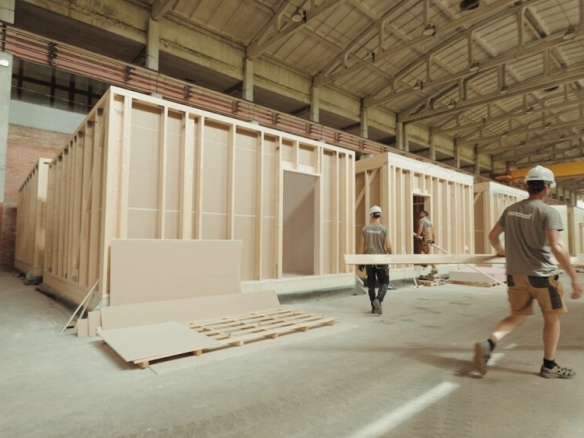
Unlike traditional building, a factory cannot operate on vague intentions. A manufacturer needs every detail resolved before production begins: Geometry, Engineering, Structural connections, Windows, doors, openings, Services routes, Finishes, Interfaces.
And Logistics, even this.
This is not a limitation. It is the greatest protection a self-builder can have.
Once manufacturing starts, your home becomes an industrial product — with traceable costs, defined quality standards and a locked timetable. And this is where prefab becomes not just a construction method, but a decision-making framework.
Prefabrication doesn’t remove risk — nothing does — but it moves risk forward into the phase where it can be measured, compared, negotiated and priced.
That single shift is transformative.
Choosing Your Prefab Strategy: The Three Axes
Every industrialised project sits along three key choices:
- The first is whether you want a pre-designed model or a fully customised design.
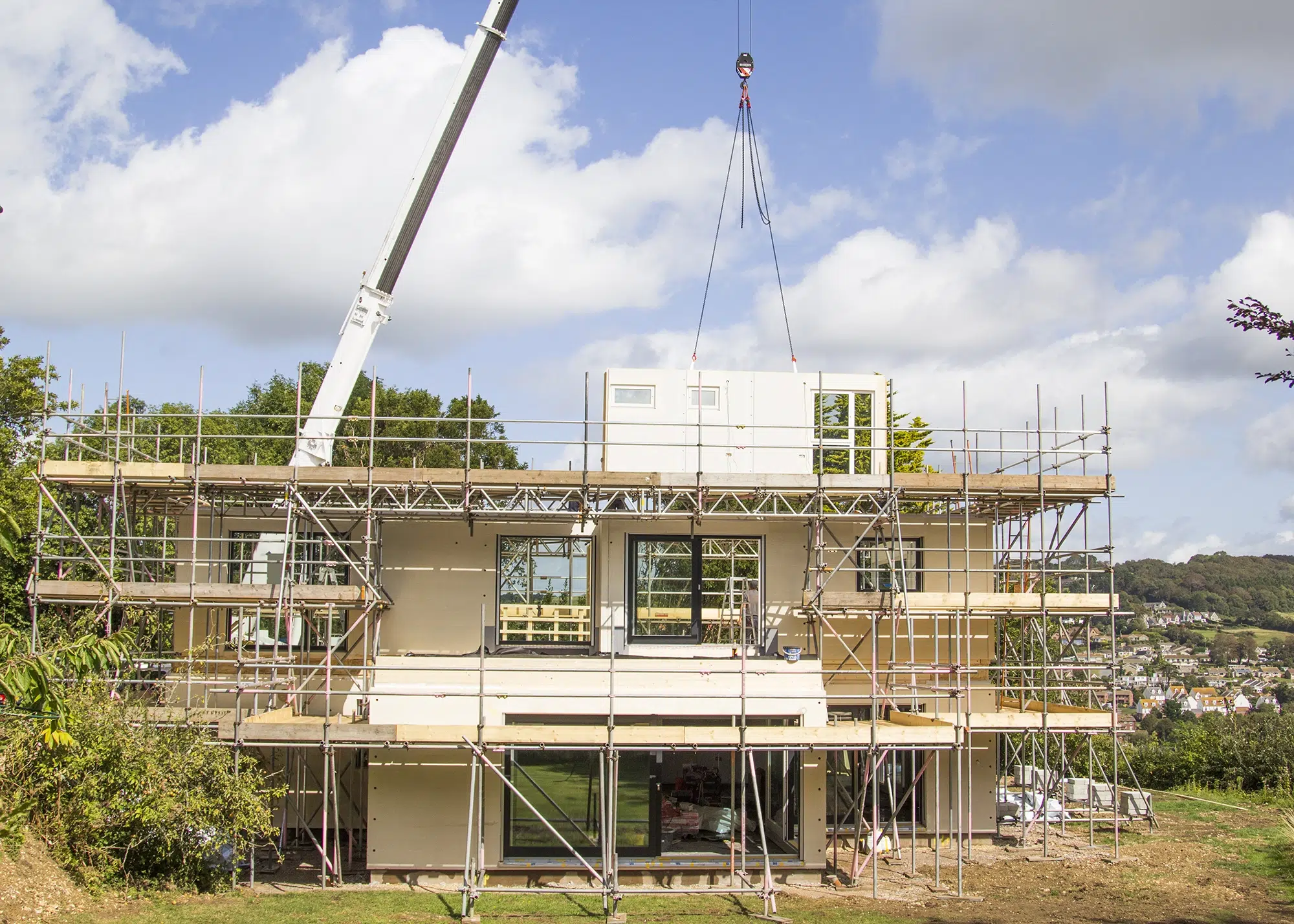
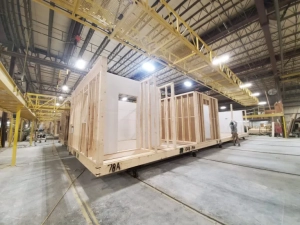
- The second concerns the construction system: three-dimensional modular units built almost entirely in the factory, or two-dimensional panelised elements assembled on site with more architectural freedom.
- The third decision is your level of involvement: a turnkey delivery where a single provider manages everything, or a shell-only approach where you coordinate the remaining trades.
How you position yourself along these axes determines how much freedom you gain, how much risk you retain and how predictable your timeline and cost become.
But across all configurations, one principle remains:
Prefab reduces uncertainty by design.
Five Strategic Advantages of Prefab for the Self-Builder
1. Certainty: The Most Valuable Material in Construction
With industrialised systems, you know the price, the performance levels and the approximate delivery date before the build begins. Weather disruptions shrink, workforce variability is reduced and materials are sourced under stable conditions. Prefab is not necessarily cheaper — but it is dramatically more predictable, and predictability is often the most valuable currency in a self build.
2. Tangibility: You Can Experience the House Before You Commit
Instead of relying on drawings and imagination, you can visit show homes, tour factories or examine prototypes. You see what you are buying. You understand proportions and materials. This shift from abstraction to evidence removes a significant portion of the emotional uncertainty that burdens many first-time self builders.
3. True Comparability Between House Models
In traditional construction, quotes vary wildly in structure and assumptions, making them difficult to compare. Prefab brings a level of standardisation that allows you to evaluate systems, performance levels, warranties and deliverables with clarity. Negotiation becomes more transparent. Decisions become stronger.
4. Geographical Independence: Quality Becomes Portable
In rural or remote areas, skilled labour can be difficult to source. Prefabrication allows you to access high-performance construction regardless of local labour availability. Quality becomes portable, not dependent on the proximity of specialists.
5. Simplified Coordination
Instead of managing a dozen or more subcontractors, you often deal with a single manufacturing contract, one logistics plan and one installation team. Most interfaces are resolved on paper during the design phase rather than improvised on a muddy site under time pressure. With fewer handovers, the margin for error shrinks.
The New Mindset of Today’s Self-Builder
Philip’s project didn’t collapse because of the €100,000 overrun. It failed much earlier — when decisions were made without structure.
Modern self-builders understand this. They know that clarity is power.
Today’s successful self builder understands that the emotional dream of building a home must be supported by the discipline of a project leader.
They know that a house is both a personal sanctuary and an industrial object. They recognise that control is more valuable than optimism. They treat cash flow with the same seriousness as design. And they understand that delay is often one of the most expensive materials on site.
Prefabrication aligns naturally with this mindset. It delivers information before commitment, structure before emotion and decisions before execution. It does not eliminate risk, but it moves risk to the moment where it can be understood and mitigated.
Conclusion: The Best Insurance You Will Ever Buy Is Clarity
The Christmas table stories will continue — tales of budgets blown wide open, timelines doubled and lessons learned too late. But your project does not need to join them.
But Philip’s story doesn’t have to repeat itself. Today’s self builder has tools previous generations didn’t: prefabrication, industrialised construction, transparent systems, and predictable pathways.
If you want your self build to be remembered for its architecture — not its overruns — begin where certainty begins:
Before you build, decide.
And consider prefabrication as the framework that helps you decide well.