4 minutes read
Can I Build a Prefab House on a Slope?
Short answer: yes — and in many cases, you probably should.
Long answer: it depends less on how steep your land is, and more on how willing you are to stop treating flat ground as the default condition for building.
Sloped sites have traditionally been framed as “difficult.” They cost more, take longer, and demand complicated foundations. But those difficulties are not inherent to the slope itself; they are largely the result of traditional construction approaches that require moving all material, machinery, and human resources to the site—turning the slope into an added complication.. Prefab construction operates according to a different logic, and that logic happens to align unusually well with uneven terrain.
Why Slopes Are a Problem for Conventional Construction
Most conventional houses begin with a single assumption: the building will sit on a continuous, level foundation. On flat land, that usually means a slab or strip footings. On sloped land, it means excavation, retaining walls, stepped foundations, drainage systems, and a lot of concrete.
The steeper the slope, the more extreme this becomes. Large portions of the site may need to be cut away, while other areas are built up artificially just to create a horizontal platform. The foundation often becomes the most expensive, carbon-intensive, and time-consuming part of the project — long before architecture even enters the picture.
This is where many people conclude that slopes are “bad sites.” In reality, they are simply bad matches for flat-site construction logic.
How Prefab Changes the Equation
Prefab houses are designed and engineered before they reach the site. Structure, load paths, tolerances, and assembly sequences are resolved in advance, usually in a factory environment. This has a direct impact on how foundations work.
Instead of relying on a continuous slab, prefab buildings can be supported by:
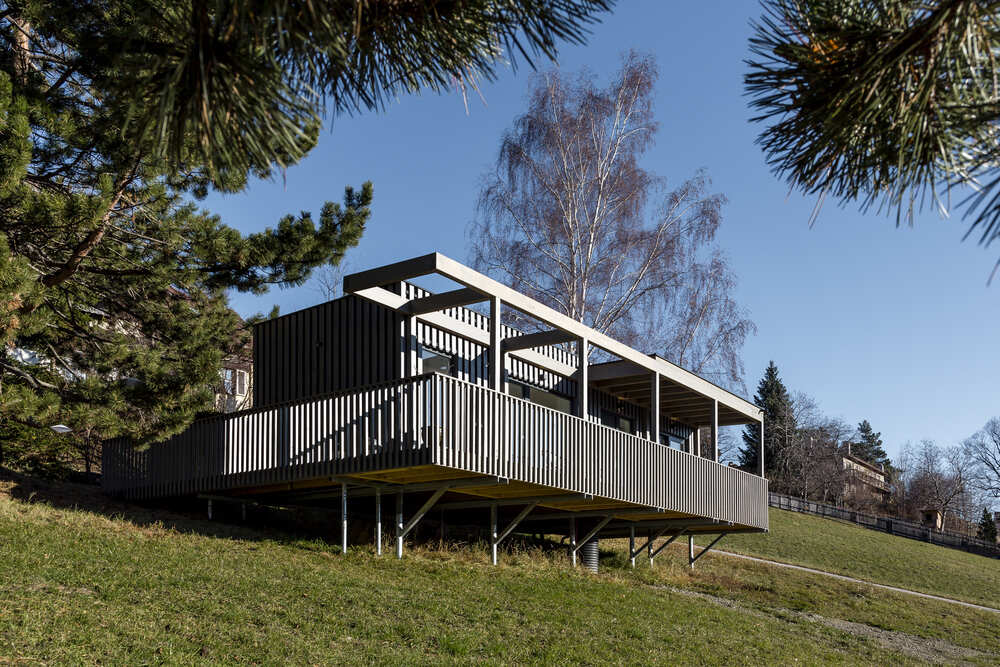
- point foundations
- screw piles
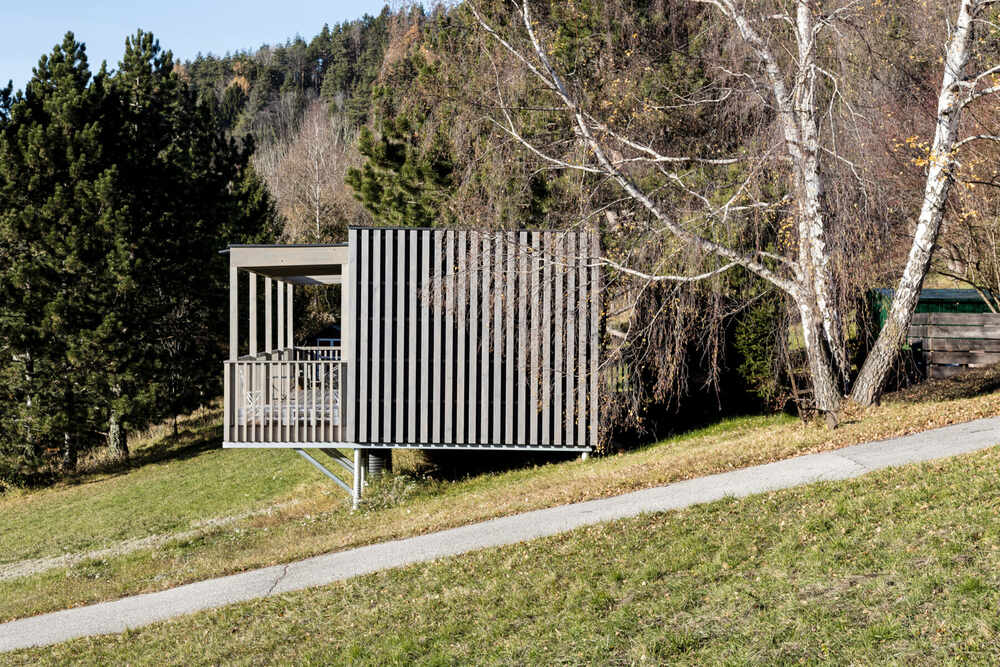
- piers or stilts
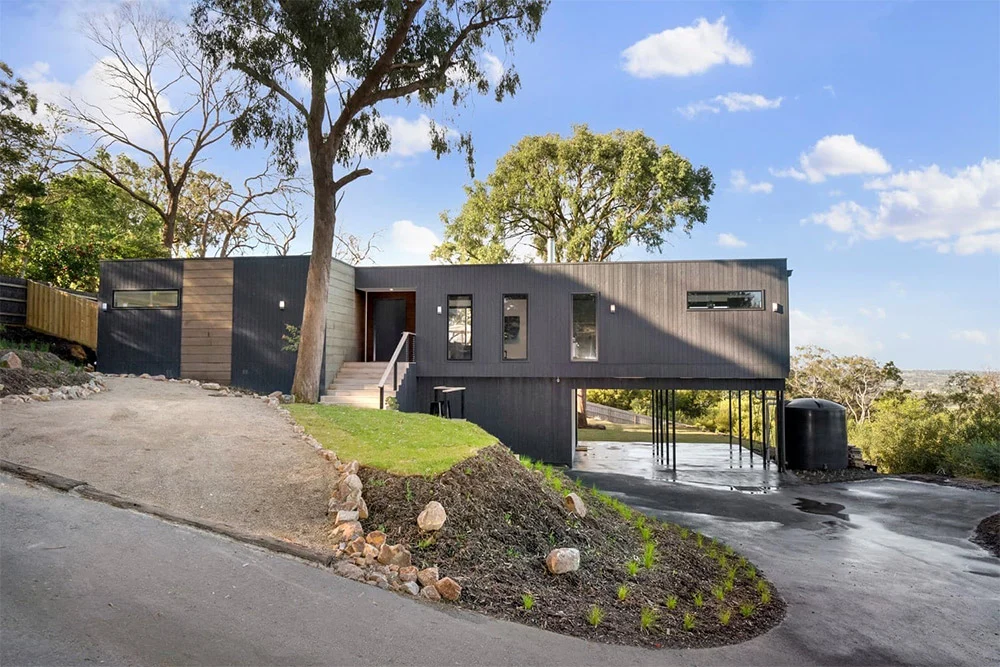
These systems transfer loads precisely, rather than evenly across a flattened surface. On a slope, that precision matters. The building no longer needs the land to be made level; it only needs the ground to receive it at specific points.
The result is a fundamental shift: the site stops dictating the building through excavation, and the building adapts to the site through structure.
Thinking about building?
Share a few details about your project and receive quotes from our network of vetted manufacturers.
GET YOUR QUOTESDo Prefab Houses Need Less Foundation?
In most sloped-site cases, yes — and this is one of prefab’s biggest advantages.
Because prefab structures are self-contained and engineered as complete systems, they do not rely on massive foundations for stability. On sloping land, this often means:
- far less excavation
- significantly reduced concrete use
- minimal retaining walls
- less disruption to drainage and vegetation
This does not mean the foundations are less engineered. Quite the opposite. They are simply more targeted. Instead of pouring concrete everywhere, you place it only where it is structurally necessary.
Is This Actually Cheaper?
It can be — but not always in the way people expect.
Prefab houses are not automatically cheaper than traditional houses. Where the savings usually appear is in site work, not in the building itself. On sloped land, avoiding heavy excavation and complex foundations can fundamentally change the project budget and timeline.
More importantly, prefab reduces financial risk. Sloped sites are notorious for surprises: unexpected ground conditions, water issues, or structural complications that emerge mid-build. Because prefab shifts complexity into design and engineering early on, many of these risks are identified — or eliminated — before construction begins.
How Steep Is Too Steep?
There is no universal slope limit beyond which prefab stops working. In practice, access and soil conditions matter more than gradient alone.
Prefab often performs best on sites that are clearly sloped, because those sites discourage attempts to flatten the land. Moderately sloping sites can sometim