7 minutes read
The term covers incremental changes such as subdividing large homes, adding secondary dwellings on existing plots, and inserting low-rise buildings into established neighbourhoods. It avoids both sprawl and towers, promising growth without rupture. That promise has helped it gain political traction. But it also raises a harder question: how much can cities really grow from within, and under what constraints?
Constraint as a driver, not a footnote
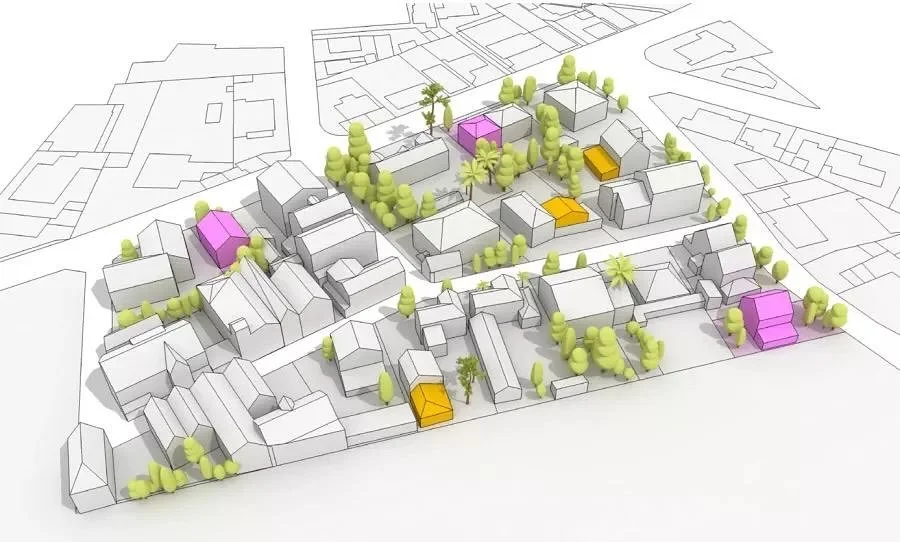
In France, the rise of densification douce reflects constraint more than conviction. As analysed by La Grande Conversation, tighter limits on land consumption have pushed housing policy away from new development zones and towards the existing urban fabric. What has emerged is not a single model but a dispersed pattern of small interventions: garden infill, plot subdivision, and modest vertical extensions. Individually these projects barely register. Collectively they signal an acceptance that land is no longer an expandable input.
Yet the strengths of this approach are also its weakness. Production relies on thousands of separate decisions by individual owners and small builders, filtered through local discretion and uneven rules. Scaling a system built on atomised choices is harder than its advocates sometimes imply.
Australia’s headline number, and what it assumes
Australia offers one of the clearest attempts to quantify the potential of incremental density. Research commissioned by the Committee for Economic Development of Australia (CEDA) suggests that close to one million additional homes could be delivered across the country’s five largest cities through modest increases in density within established suburbs. The number is striking and revealing. It rests on assumptions that rarely hold uniformly in practice: permissive planning rules, sustained demand for medium density housing, and political acceptance of neighbourhood change.
New Zealand’s recent experience suggests that capacity can be unlocked when the rules are unambiguous. Auckland’s upzoning, and subsequent national reforms that enabled three homes up to three storeys on many urban sites, show how regulatory clarity can shift a market towards medium density delivery, as set out in the New Zealand Ministry for the Environment’s Medium Density Residential Standards guide.
Britain’s uneasy compromise
In the UK, gentle densification is often framed as a design question. Advocates argue that resistance to new housing reflects poor form rather than density itself. This is not wrong, but it sidesteps the central tension. Low-rise, high-quality density tends to be slower and more land-intensive than large redevelopment schemes. It may be easier to accept politically, but it does not automatically deliver housing at scale, especially in a planning system that still makes small sites unusually costly and uncertain to build out.
California’s quiet success, and its limits
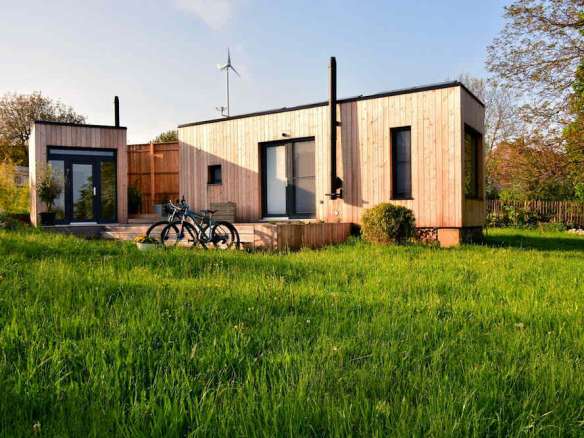
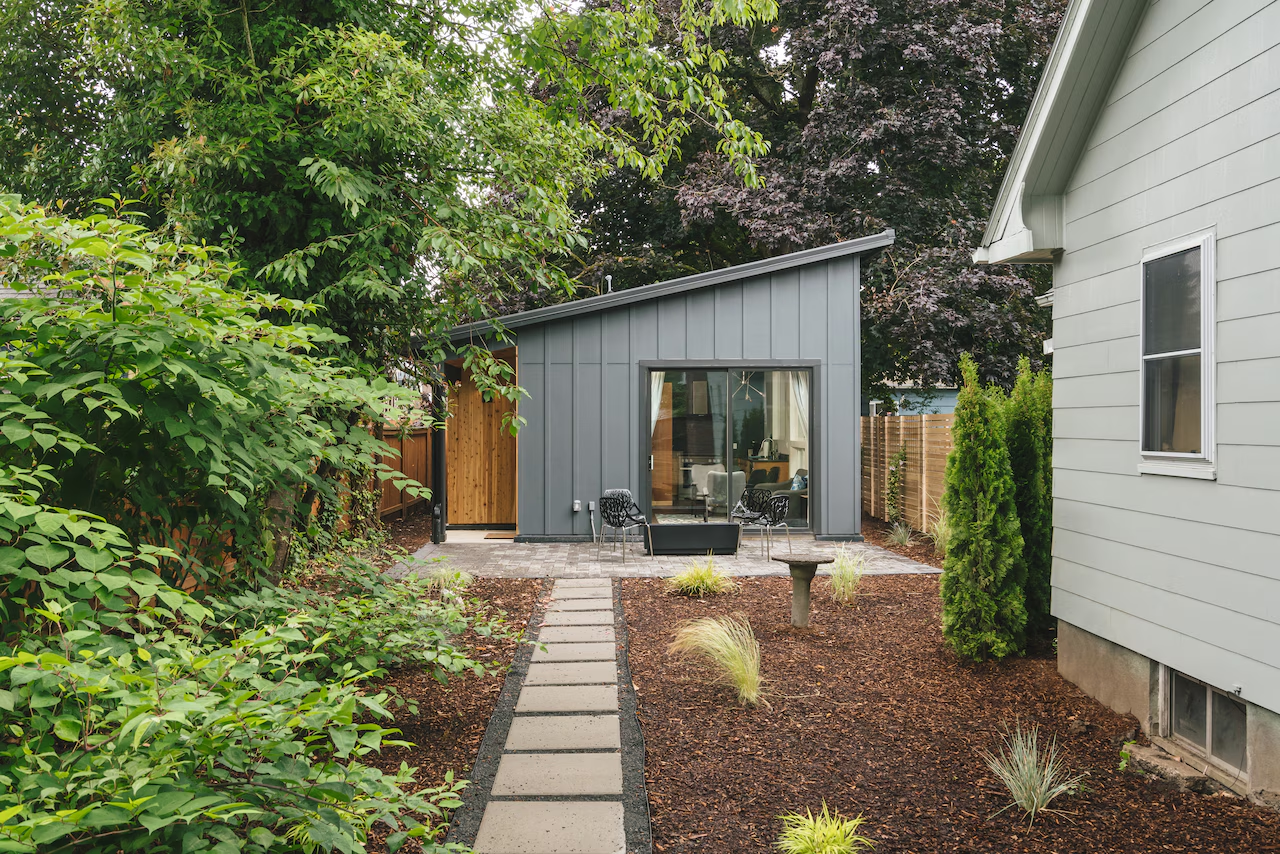
California is often cited as proof that gentle densification can operate at scale. Over the past decade, the state has dismantled local barriers to accessory dwelling units (ADUs), standardising approvals and constraining restrictive zoning. The results are real. Annual ADU permits have surged as the legal pathway has been simplified and normalised, a trajectory summarised in Brookings’ discussion of California’s decade-long effort to legalise ADUs and consolidated in the state’s ADU handbook update.
In some California markets, the ADU channel has become comparable to—sometimes larger than—traditional single-family home production on a permit basis. In San Diego County, for example, reported 2023 figures show ADU permits exceeding permits for single-family homes (as summarised by BD+C). In Los Angeles, a California YIMBY retrospective notes that “one in every three homes permitted” in the city in 2022 was an ADU (see the California YIMBY ADU report). These are not statewide statements, but they do illustrate how quickly “small” units can scale when approvals are standardised and friction is systematically removed.
This does not mean ADUs have solved California’s housing crisis. But they do show that thousands of small decisions can aggregate into meaningful supply without sprawl or towers, provided the system is designed to let them. Reporting on the scale—and limits—of that model in San Diego is discussed in New America’s account of ADUs.
Thinking about building?
Share a few details about your project and receive quotes from our network of vetted manufacturers.
GET YOUR QUOTESThe climate constraint within cities
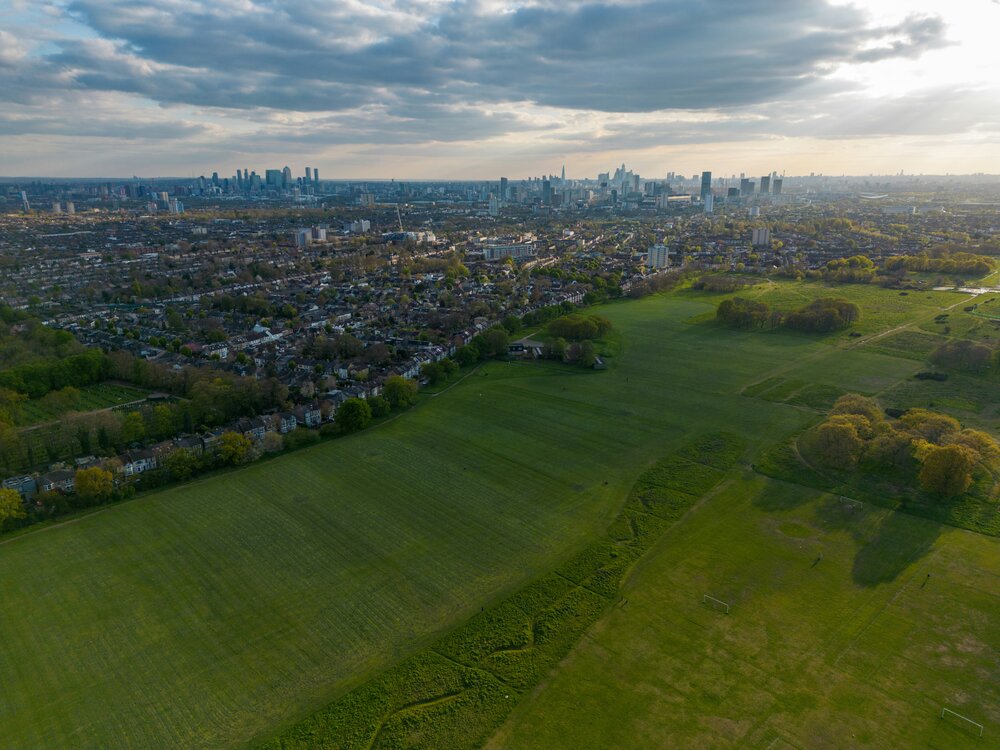
As inward growth becomes unavoidable, another constraint is becoming harder to ignore. Many cities are removing road space, parking and other impermeable surfaces, replacing them with trees and planted public space. Asphalt and concrete are increasingly treated as contributors to heat stress rather than neutral infrastructure.
In this context, building on urban green space, even in small quantities, risks undermining climate adaptation. Inward growth remains necessary, but it narrows the conditions under which densification makes sense. Additional units must stay small in footprint, limit soil sealing, retain trees and meet permeability standards. In practice, that favours building on already mineralised land—lanes, courtyards and garages—and in neighbourhoods less exposed to heat stress. Densification, in other words, cannot be spatially uniform.
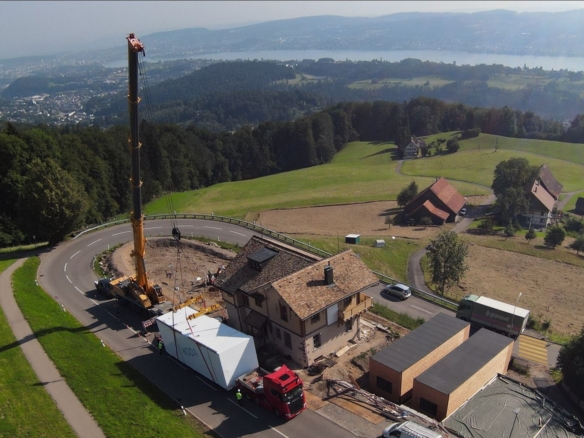
Those constraints also change the delivery logic. Prefabrication is compelling in this setting because it reduces two frictions that most often kill infill: disruption and ground disturbance. Paired with screw pile foundations, prefab can limit excavation, spoil removal and soil disruption. And because installation can be measured in days rather than months, it materially reduces noise, dust and street occupation, lowering the likelihood of neighbour opposition that can otherwise stall incremental projects at scale.

A choice policymakers can no longer defer
Gentle densification has gained favour precisely because it appears to offer progress without conflict. It lets governments claim action on housing while avoiding the political costs of outward expansion or large-scale redevelopment. In that sense it has functioned as a pressure valve, easing shortages at the margin while postponing harder decisions.
That period of postponement may be ending. If cities are to rely on inward growth, policymakers will have to make explicit choices they have so far avoided. They will need to decide where density is acceptable and where it is not, and which neighbourhoods can absorb additional housing without losing climate resilience. They will also have to confront scale. Incremental infill can contribute meaningfully to supply, as California shows. But it cannot be expected to carry the full burden of demand unless planning systems are deliberately redesigned to support it, with clear rules on height, footprint, permeability and tree retention, rather than leaving outcomes to chance, discretion and local resistance.
In a warming climate and a tightening housing market—where solutions that improve one side often worsen the other—gentle densification can look like a sensible middle way, although it struggles to deliver at scale. For that reason, it should be considered a component of planning strategy rather than a standalone solution to housing shortages.
The practical test is whether governments are willing to do the unglamorous work that makes incremental supply reliably additive rather than incidental: simplifying approvals, standardising requirements, and reducing the soft costs that make small sites disproportionately difficult to deliver. At the same time, the climate constraint cannot remain an afterthought. If inward growth is to be the main pathway, it needs a clear spatial logic—one that protects high-value urban green space and prioritises already mineralised land, while making adaptation goals (tree retention, permeability, heat exposure) explicit in the rules rather than negotiable in each case.
Where those conditions hold, “gentle” densification can accumulate into material supply and broaden housing choice without forcing cities into a false binary of sprawl versus towers. Where they do not, it risks becoming a rhetorical compromise—promising progress without rupture while leaving the underlying scarcity intact.